
Platform Overview
Argus: A Control Plane for Autonomous AI Agents
Argus isn't a rip-and-replace for the identity and access systems you're already running. It's the layer that ties them together for agents specifically, built to sit on top of what you have, not to ask you to tear it out.
In practice, that means Argus reads from the identity provider and directory you already run, rather than asking you to stand up a separate one for agents. It doesn't own your source of truth for who your people or systems are, it consumes it, and layers agent-specific identity, policy, and credentialing on top. The same goes for the data and tools your agents touch: Argus doesn't require migrating anything into a new store, it enforces decisions against what's already there.
AI agents are moving out of chat windows and into production systems. They read from databases, call internal APIs, trigger workflows, and increasingly, act without a human confirming each step. That shift changes what security has to mean. A chatbot that gives a wrong answer is embarrassing. An autonomous agent with standing access to your CRM, your billing system, or your customer data, acting on a bad instruction or a compromised prompt, is a different category of risk.
Most organizations didn't build for this. Service accounts, static API keys, and broad IAM roles were designed for humans and predictable services, not for software that plans its own next step. Argus exists to close that gap. It's a control plane purpose-built for AI agents, sitting between every agent and everything it touches, so every action is identified, authorized, and recorded before it happens, not investigated after the fact.
Architecture
What Argus actually does
Argus evaluates every request an agent makes against real-time identity, data sensitivity, and policy context, before that request is ever allowed to proceed. It answers one question, continuously: is this specific agent allowed to do this specific thing, right now.
That question breaks into four parts, and each one is handled by a dedicated part of the platform.
Agent Registry
Knows which agents exist, who owns them, and what they're allowed to do in principle.
Annotated Data Catalog
Knows what data and tools exist, and how sensitive each one is.
Real-Time Credentialing
Issues the actual permission to act, scoped narrowly and built to expire.
Foundational Auditing & Analytics
Records what happened, in a form that holds up under a compliance review.
None of these work alone. An agent doesn't get a credential because it asked nicely. It gets one because the registry confirms it exists and is active, the catalog confirms the resource it wants is something it's allowed to touch, and a policy decision permits that specific request. Every check happens in real time, on every call.
Coverage
Every kind of agent interaction, not just one
Most conversations about agent security focus on a single pattern: agent to agent, agent to tool, or agent to data. Argus doesn't pick one. An agent calling another agent, an agent reaching into an MCP server or another tool, an agent touching a resource or data source directly, all of it goes through the same identity check, the same policy evaluation, and the same scoped credential. What's on the other end of the request doesn't change how it gets secured.
Request lifecycle
How a request actually flows
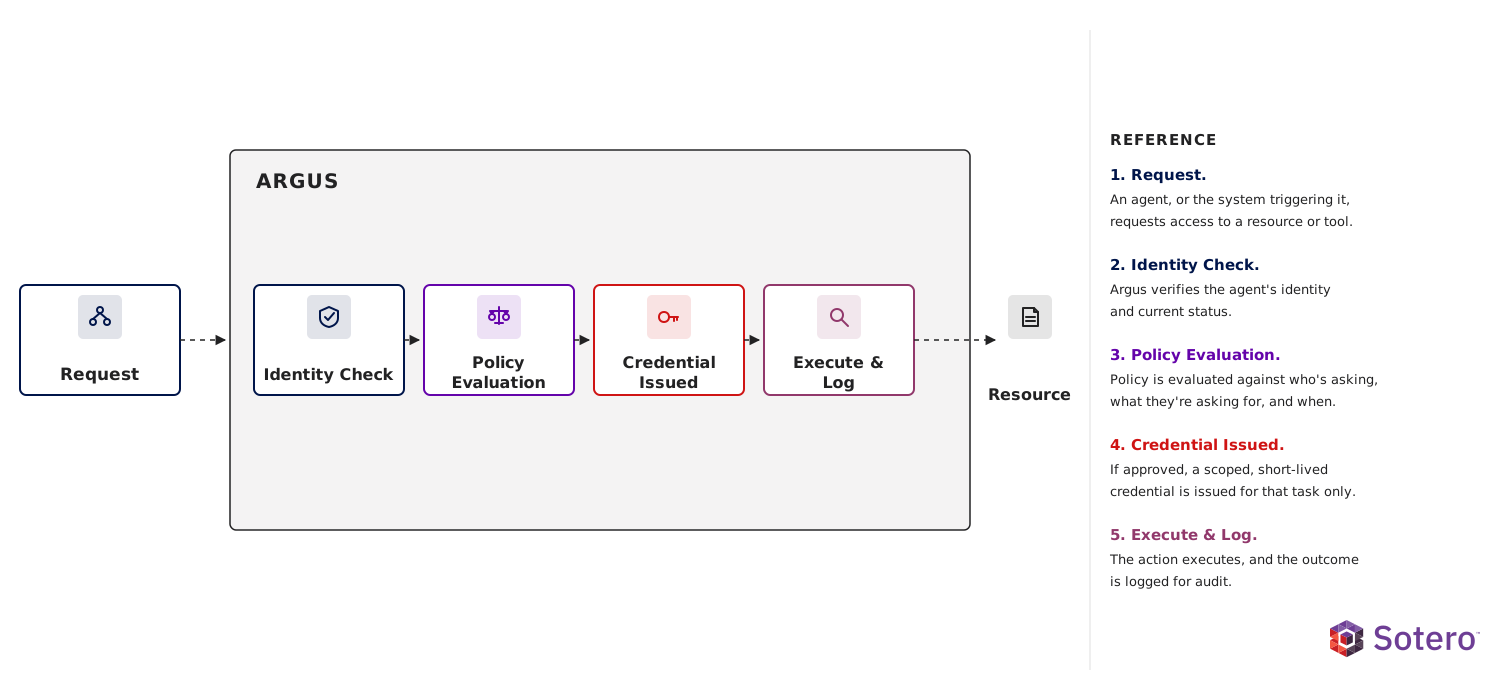
Take a concrete case. A support agent tries to pull up a customer record to answer a ticket. Argus checks the agent's identity and status first, confirming it's registered and active. Next it evaluates policy: is this specific agent allowed to read this specific kind of record, under the conditions written into the rule. If the answer is yes, Argus issues a credential scoped to exactly that request, valid only long enough to complete it. The agent reads the record, the action is logged, and the credential is already gone by the time the next request comes in. Nothing in that sequence is inferred or guessed, every step is a checked, logged decision.
Why real time, not after the fact
A security review that happens after an agent has already acted is a postmortem, not a control. Argus makes the decision before access is granted, every time, so there's no window where an agent is operating on trust alone. That's the difference between a system that can explain what happened and one that can actually prevent it.
Library
Where to go deeper
The rest of this library covers each piece on its own: how agents get registered and tracked, how policy actually gets evaluated, and how credentials work without any agent ever holding standing access to anything.
See Argus evaluate a live request
Get a guided walkthrough of the Argus control plane on your own agents.