
Deep Dive
Inside the Agent Registry
Before an agent can act, it has to exist on paper: a real record with an owner, a defined scope, and a status that can change. That's the registry's whole job. It's the difference between "we think we have about forty agents running somewhere" and knowing exactly what's live, who's responsible for it, and what happens the moment that changes.
Registry record
What gets tracked
The registry isn't a spreadsheet of agent names. Each entry carries the information that actually matters when something goes wrong or something needs to change quickly:
Identity
A verifiable identity distinct from any human user or generic service account.
Ownership
A single accountable owner, not a team, not "whoever built it."
Scope
What the agent is allowed to do in principle, before any single request is evaluated.
Lifecycle status
Where the agent currently sits: registered, approved, active, restricted, or retired.
That last one matters more than it sounds like it should. An agent's status is the first gate every access request passes through. An agent that's been restricted doesn't need its credentials revoked one by one. It needs its status changed once, and every subsequent request fails closed automatically.
Ownership
Why single ownership is a deliberate choice
It would be simpler to let an agent belong to a team, or to no one in particular. Argus doesn't allow that. Every agent has exactly one accountable owner, enforced at registration, not as a policy suggestion. We believe this mirrors how the industry is already handling non-human identity more broadly: ownership converges on a single accountable person almost everywhere agents run at scale, because "who's responsible for this" needs a one-word answer during an incident, not a team roster.
Lifecycle
The lifecycle in practice
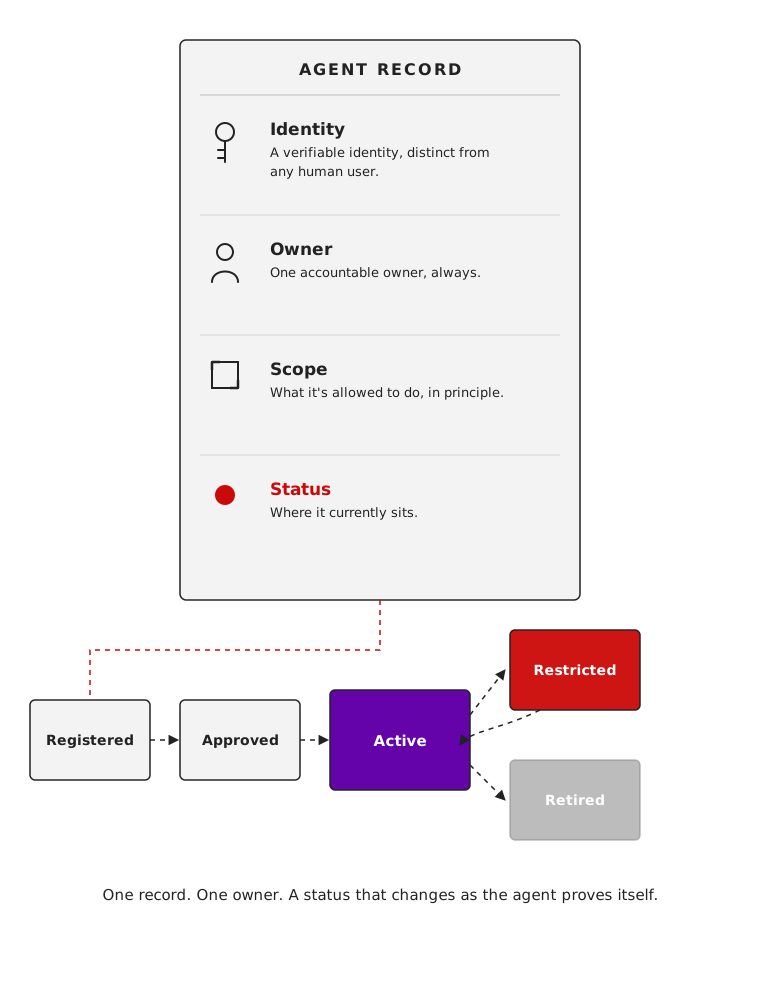
A newly registered agent isn't automatically active. It moves to approved once ownership and scope are confirmed, then active once it starts making real requests. If behavior later looks wrong, an agent can move to restricted without a full deregistration, cutting off new access while preserving its audit history. Retirement is permanent and closes the loop.
Say a billing agent is registered by a finance engineer, approved once its scope is confirmed to read-only invoice access, and moved to active as it starts handling real requests. At some point its behavior looks off, it starts requesting records outside its normal pattern. Without deregistering anything, its status flips to restricted. New requests fail closed immediately, while its full history stays intact for review. If the review clears it, status moves back to active. If not, it's retired, permanently, and that record stays as the audit trail of exactly what happened and when.
What the registry doesn't do
It's worth being clear about the boundary here. The registry answers "does this agent exist, is it active, and who owns it." It doesn't make the access decision on its own. That's a separate evaluation, informed by the registry's answer but combined with data sensitivity and policy, the subject of the next two pages.
See the registry in action
Get a guided walkthrough of the Argus control plane on your own agents.