
Deep Dive
Zero-Trust Credentialing, Explained
A credential that never expires is a credential that's already been stolen. It just hasn't been used yet. That's the uncomfortable truth behind most agent breaches, and it's why Argus never issues a credential that outlives the task it was meant for.
The problem
The problem with standing access
Traditional service accounts hold broad, long-lived permissions because provisioning them narrowly, every time, for every task, was too much operational overhead to do by hand. That trade-off made sense when the thing holding the credential was a predictable service with a small number of code paths. It doesn't hold up for an agent that plans its own next step. A single leaked long-lived key can mean unrestricted access for as long as it takes someone to notice.
Ephemeral and scoped
What ephemeral and scoped actually mean
Every credential Argus issues is built around two constraints. It's scoped narrowly to the specific task the agent was just approved to perform, not to everything the agent might ever need. And it's short-lived, expiring automatically once the task window closes, whether or not the agent used it. Neither of these is a configuration option turned on by a careful admin. It's how the system issues credentials by default.
Credential lifecycle
The lifecycle of a credential
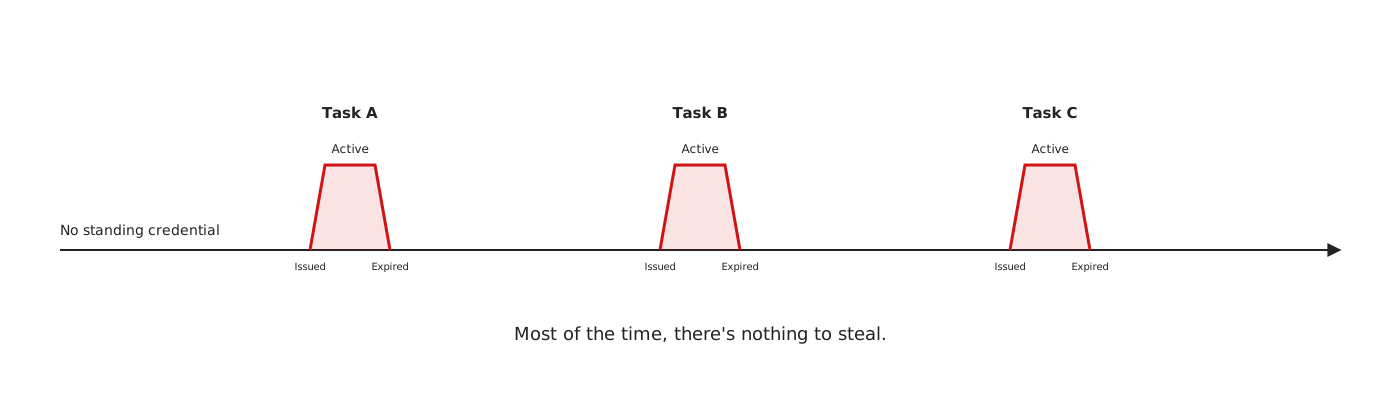
A credential is requested only after identity and policy checks already passed. Once issued, it's valid for exactly the task it was scoped to, and it can't be replayed if intercepted or reused for a second, similar-looking request. When the task window closes, it expires on its own. There's no step where someone has to remember to revoke it.
Zero standing privileges, in practice
This is what "zero standing privileges" actually means day to day: at any given moment, an agent that isn't actively mid-task holds no usable credential at all. Not a credential with narrow permissions sitting dormant. No credential. That's a meaningfully smaller attack surface than even a well-scoped long-lived key, because there's simply nothing sitting around to steal between tasks.
Here's what that difference costs in practice. However long it takes to notice a leaked credential, a long-lived key stays exploitable for every moment it goes unnoticed, because nothing about it changes on its own. A leaked Argus credential is a different problem entirely: it's scoped to one task and expires whether or not anyone catches the leak. Detection speed barely matters, because there's nothing left to steal once the task window closes.
The bigger picture
How this fits the bigger picture
Credentialing doesn't work in isolation. It's the enforcement moment that follows registry validation and policy evaluation, and it feeds directly into the audit trail once a task completes. See The Four Pillars of Agentic AI Security for how all four pieces work together.
See ephemeral credentialing in action
Get a guided walkthrough of the Argus control plane on your own agents.